Essay
A little pressure helps. A lot doesn't.
A plain-English walkthrough of the Yerkes-Dodson Law — the 1908 mouse experiment that explains why deadlines work, why interviews choke you, and what to do about it.
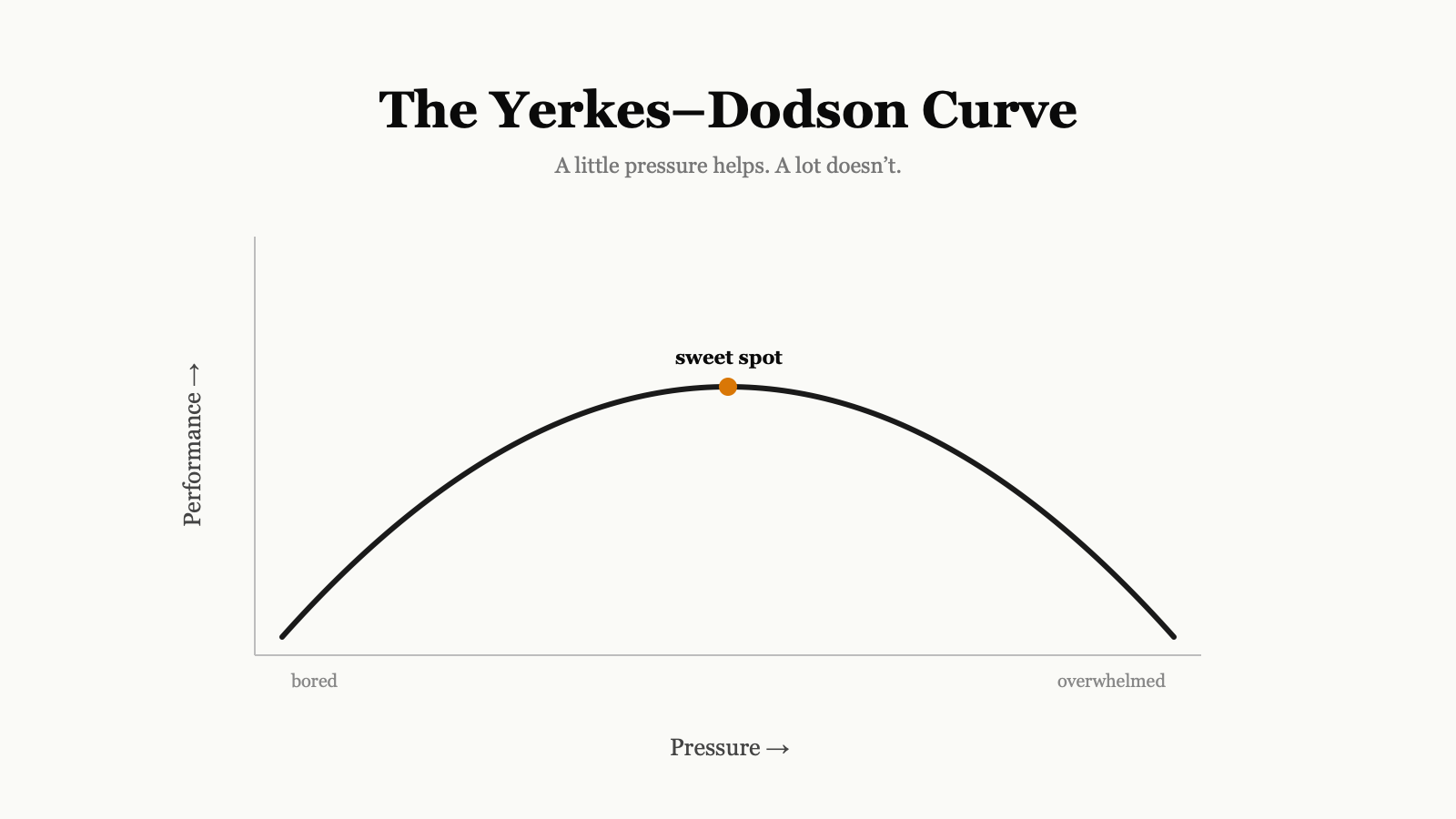
In 1908, two psychologists at Harvard — Robert Yerkes and John Dodson — put mice in a box with two doors. One door was painted black. The other was white. The mice had to learn to pick the white one. If they picked the black one, they got a small electric shock.
The real question wasn't whether the mice could learn it. They could. The question was: does a bigger shock make them learn faster?
The answer they got is now one of the most cited findings in psychology. They published it that same year in the Journal of Comparative Neurology and Psychology, and it's been known as the Yerkes-Dodson Law ever since.
What they found
When the shock was weak, the mice learned slowly. When the shock was moderate, they learned the fastest. When the shock was strong, they got worse — panicky, confused, slower than before.
Performance didn't keep going up with pressure. It rose to a peak and then fell back down.
If you draw it on a chart, you get an upside-down U.
That curve is the whole idea. A bit of pressure wakes you up. Too much pressure breaks you.
The part most people miss
The law has a second half — and it's the part that's actually useful.
The shape of the curve depends on how hard the task is.
- For simple, well-practiced things — sprinting, lifting, drilling something you've done a hundred times — the curve isn't really a U. More pressure just keeps helping. You want to be fired up.
- For complex, unfamiliar, or difficult things — solving a problem, writing carefully, having a hard conversation — the peak comes early. Past it, performance falls off fast.
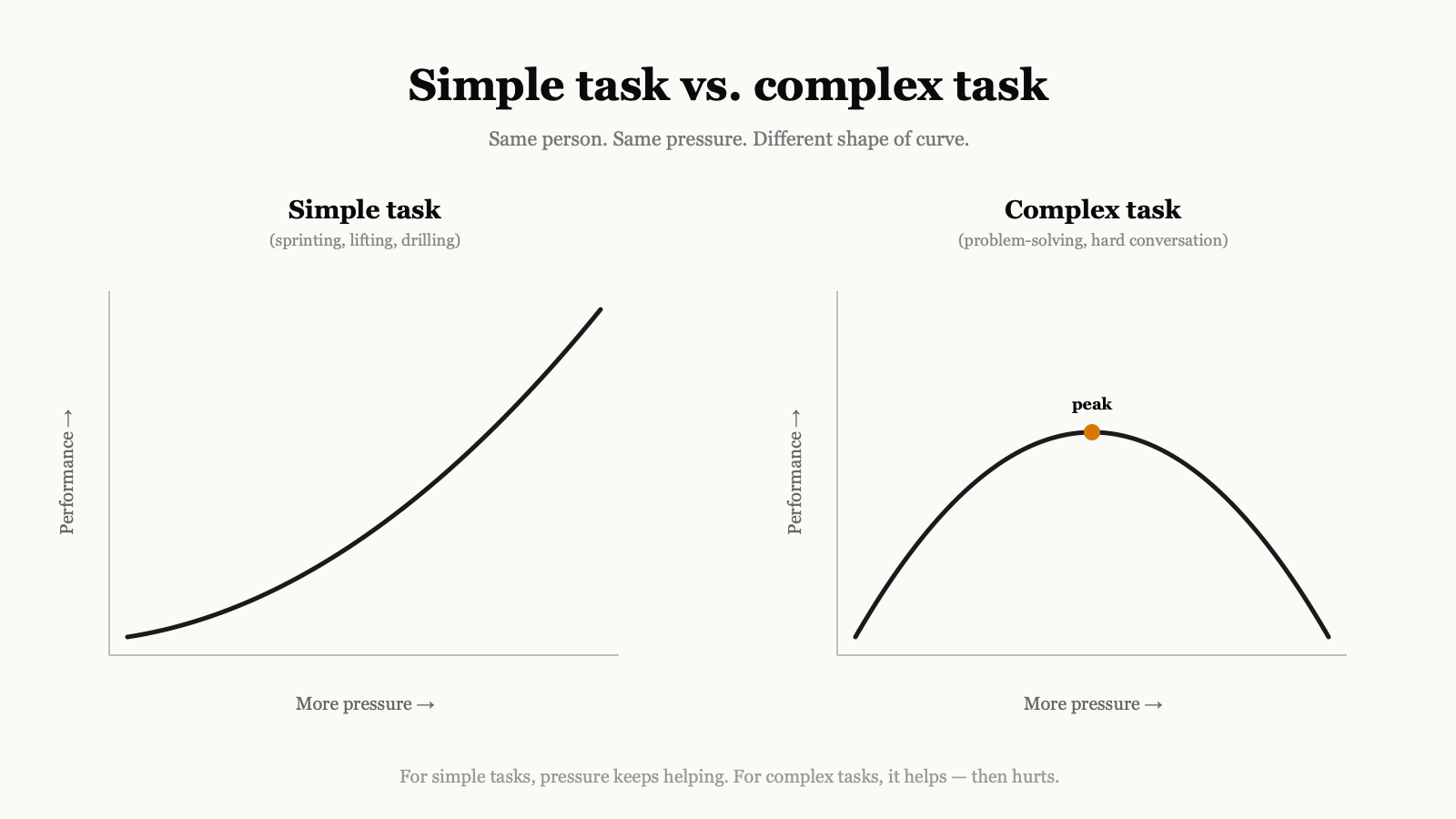
This is why a 100m sprinter runs faster when the crowd is roaring, but a chess player plays worse. Same body. Same brain. Different shape of curve.
It's also why the advice "just stay calm" works for some tasks and is useless for others.
Where you've already felt this
You've been on this curve your whole life, even without knowing the name.
- The deadline that finally gets you to start writing? That's the curve doing useful work.
- The job interview where you suddenly forget your own name? That's the curve doing damage.
- The exam where you knew everything an hour earlier but can't think now? Same.
- The coding bug you can't crack at midnight, but solve in two minutes after a walk? Same.
Same physiology. You just slid too far along the curve.
What to do with it
You can't always control how much pressure is on you. But you can usually nudge yourself toward the middle of the curve.
When the task is hard, you want less arousal. Lower the stakes in your own head. Walk. Breathe. Close the door. Close the tabs. Tell yourself the result doesn't matter — even when it does. Anything that quiets the alarm in your body will help you think.
When the task is simple but you're stuck, you want more arousal. Raise the stakes. Set a 20-minute timer. Tell a friend you'll send it by 5pm. Promise yourself coffee when it's done. Make the task feel urgent.
You're not adding willpower. You're just sliding yourself back into the sweet spot.
A caveat
For all its fame, the law isn't airtight.
Modern psychology has poked holes in it for a hundred years. What counts as "arousal" is fuzzy. What counts as "performance" is fuzzy. The exact shape of the curve depends on the experiment, the species, and the task. There are competing theories — Reversal theory, for example, argues that the mind flips between modes rather than sliding along a smooth curve.
So treat the Yerkes-Dodson Law as a useful mental model, not a physics equation. It won't tell you exactly how much pressure to apply. But it gives you the shape of the thing — and most of the time, that's enough.
A little pressure helps. A lot doesn't. The trick is knowing which kind of task you're staring at, and which way to nudge yourself.
Sources: Yerkes-Dodson law (Wikipedia). Original paper: Yerkes, R. M., & Dodson, J. D. (1908). "The relation of strength of stimulus to rapidity of habit-formation." Journal of Comparative Neurology and Psychology, 18, 459–482.
Keep exploring
All posts →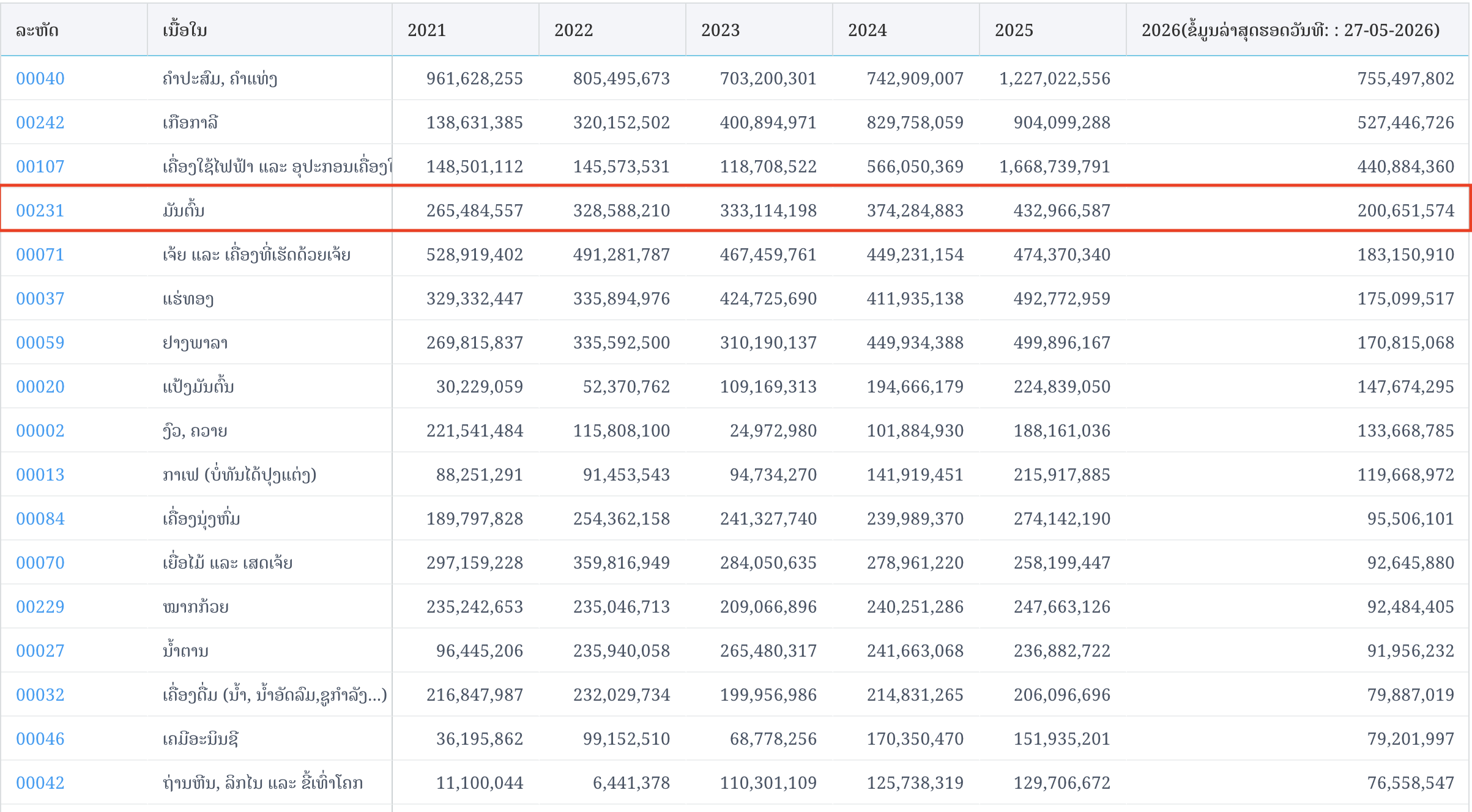
Laos exports $1.3 million of cassava every day
Lao cassava export values from 2021 to mid-2026, with a destination breakdown. In 2025 the total reached $432M, with 89% going to Thailand.
1 min read

In praise of small bets
Why I'd rather ship five small things than plan one big one — and the kinds of problems where that breaks down.
1 min read

Writing is debugging your thoughts
The act of putting a half-formed idea into a sentence is the most reliable way I know to find out whether it actually holds up.
1 min read